We had a dilemma - how would we tour Taroko Gorge ? There were three options presented to us at the Tourist Centre - touring by local bus, by tourist bus or by tour. We decided on the latter- a wise choice as it turned out. (Even though dear reader, I am not a fan of organised tours), both bus companies tour the Gorge, dropping off at various stops but unfortunately it can up to an hour’s wait for the next bus or continue walking to the next stop in 30+ degrees.
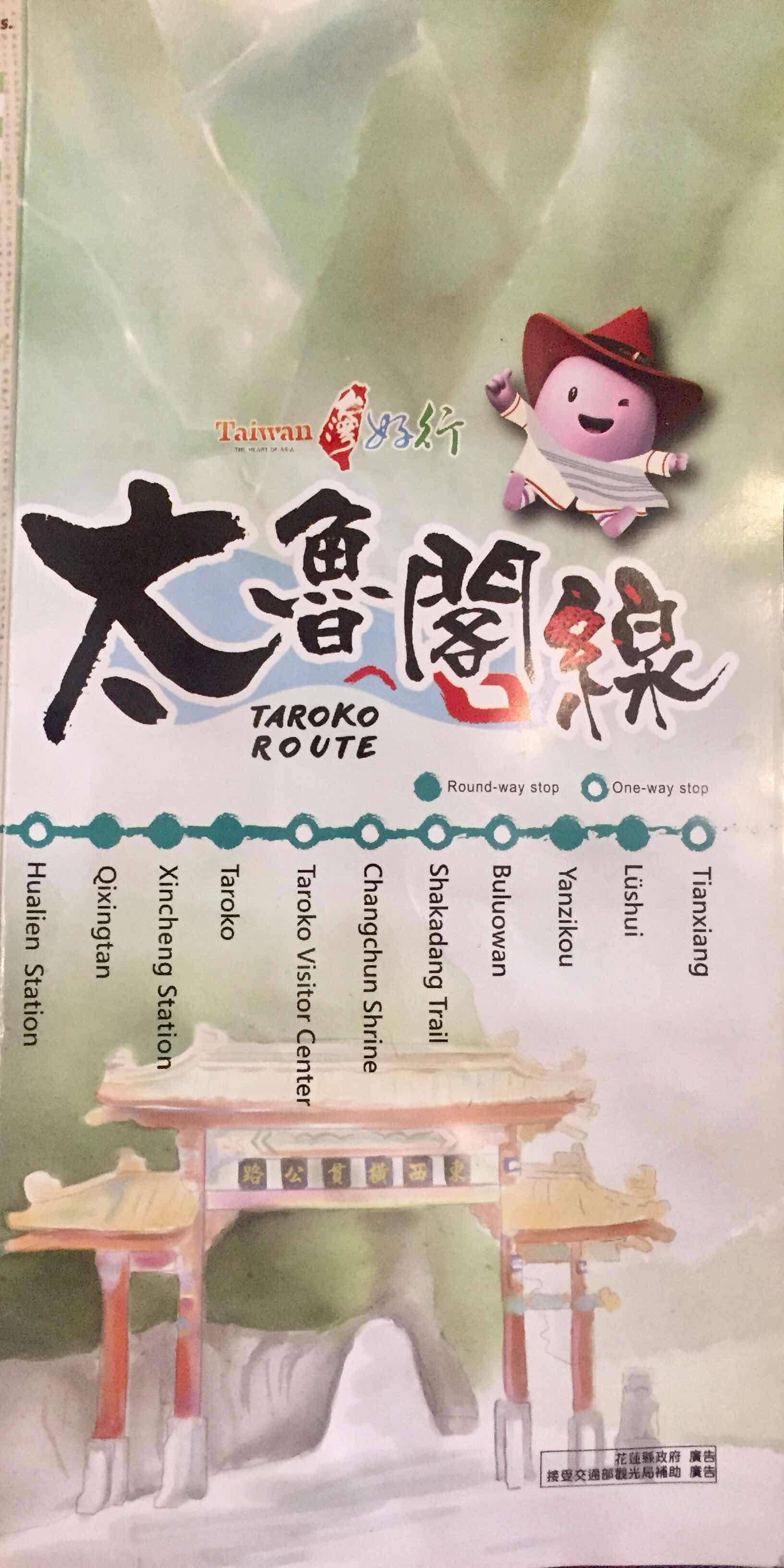
We were collected from our hotel at 0830. We’re now accustomed to being the only Caucasian’s and the only English speakers about! The driver communicated with us by Google Translate - very efficiently, I might add!!
There were 9 in our party - some local - maybe all Taiwanese? We drove to the Gorge from Hualien, the nearest town to the Gorge (c. 45 minutes). Our first stop was at Cingshuei cliffs, which rise to 1,000m
above sea level - with a history of Pacific adventurers passing by.

The scenery was stunning. As I saw the trail to the beach was open so I commenced walking but a few steps down it was closed.

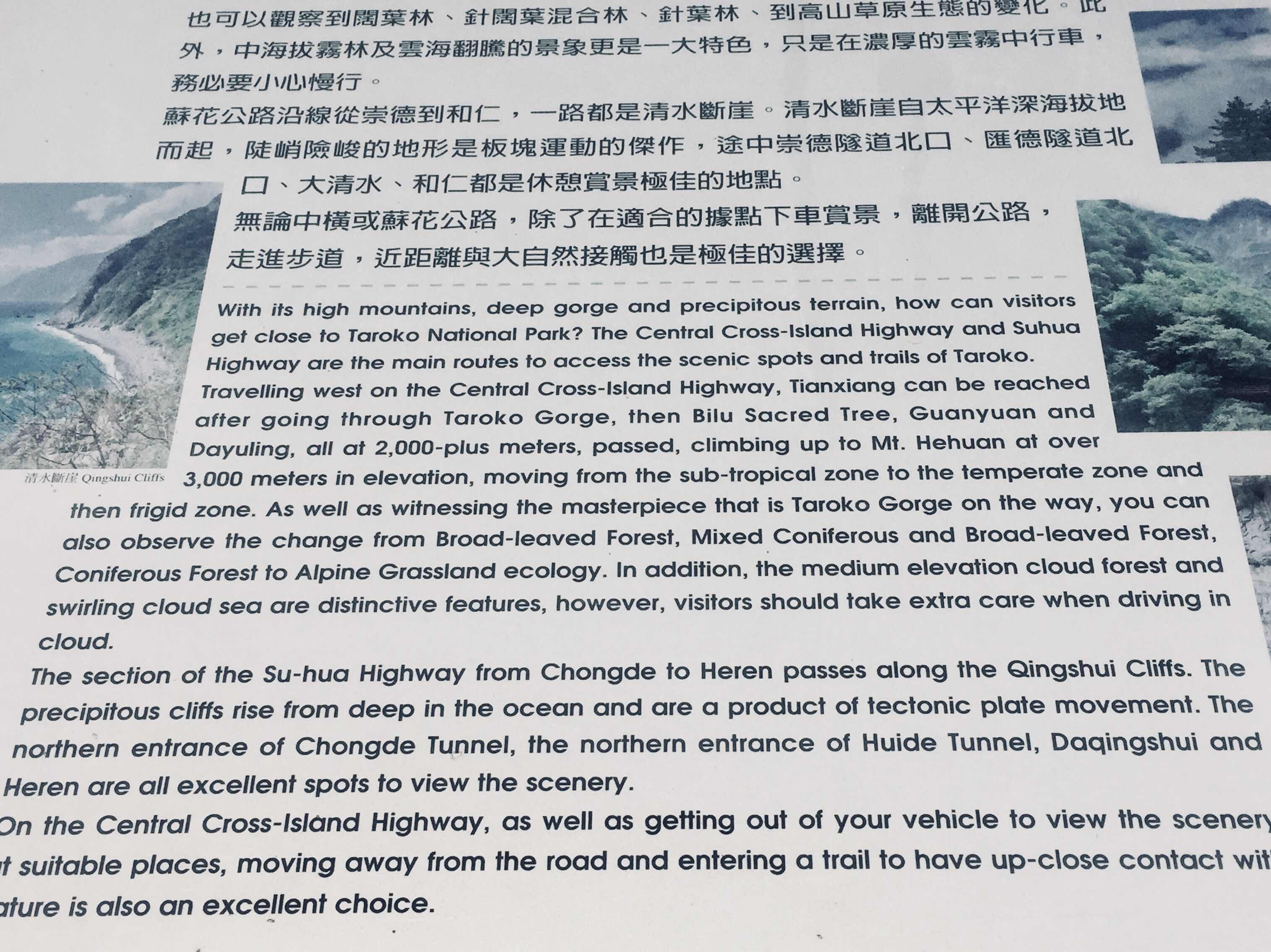
The cliffs were created by the collision of the Philippine and the Eurasian Plates c. six million years ago. As the earth’s crust was uplifted, the island of Taiwan was formed. The river Liwu which eroded the Taroko Gorge enters the sea just north of here.

From here we drove to the entrance of Taroko Gorge. The Taroko Gorge is the number one attraction in Taiwan. (It is possible to take a day trip from Taipei but it would be a long day). Taroko is famous for the gorge landscapes with marble rocks on both sides of the Luwu river valley on tge Central Cross Inland Highway from Taroko toTianxiangong and beyond

The Gorge Entrance
From there to the Buluowan Plateau - a former Tarokan mountain village - this was one of the only places suited to habitation in the valley.

The Torokan tribes had an established social pecking order as we do today but here it was based on the ability to produce life’s necessities.

We walked the short trail. A trail in Taiwan is not a dirt track but rather a series of steps in this case created from wood.
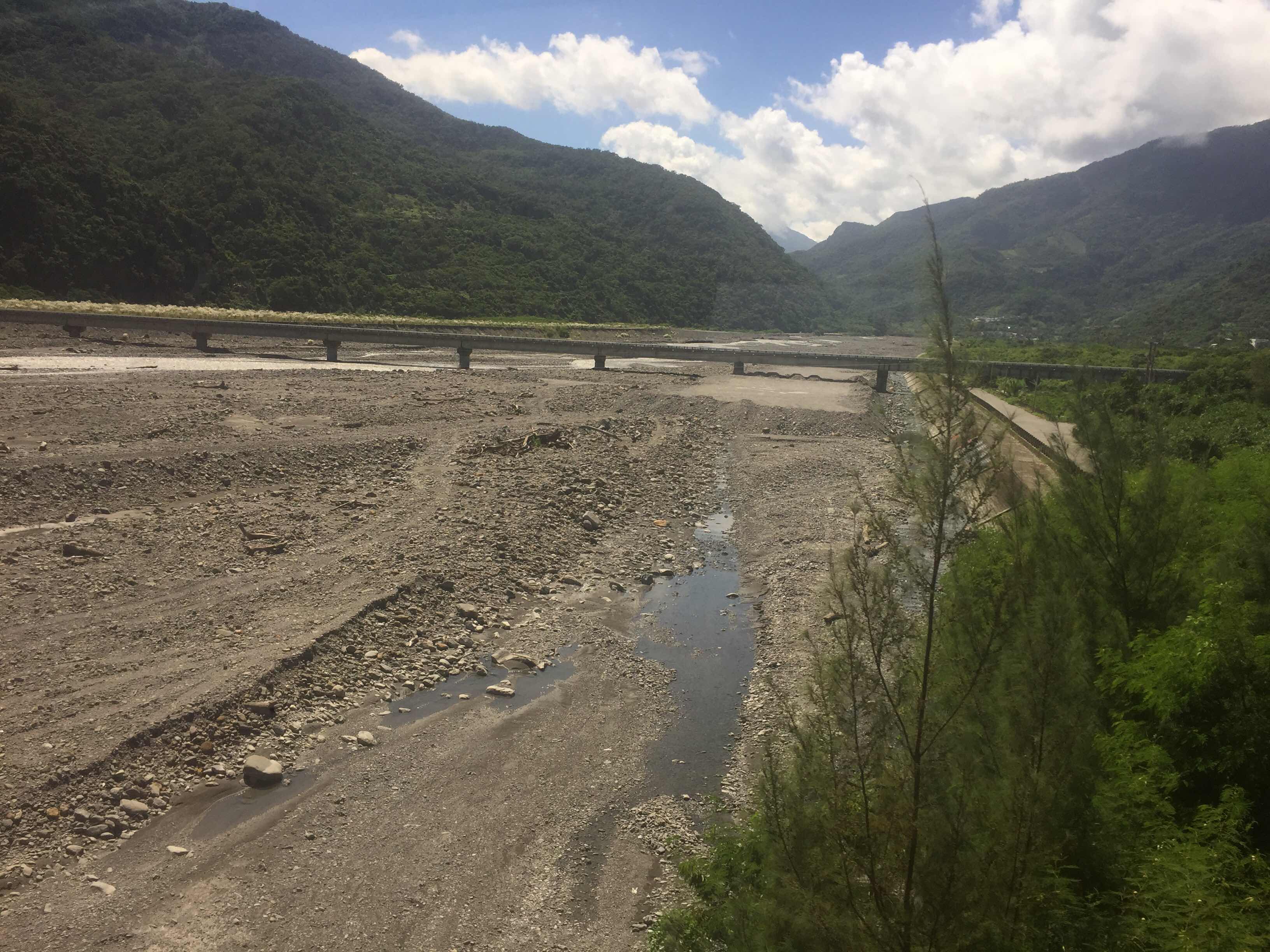
The slopes here on the lower course of the river Liwu were forested. The water level was low and large boulders could be seen in the river.

We continued to Yanzikou, colloquially known as Swallows Grotto, so named because of the phenomenan of hundreds of swallows singing in the valley. The bird song here was of orchestral quality.
We continued to Yanzikou, colloquially known as Swallows Grotto, so named because of the phenomenan of hundreds of swallows singing in the valley. The bird song here was of orchestral quality.

Here, prior to entering the Grotto, one was issued with a hard hat.

Not only is this area prone to typhoons, it is also prone to earthquakes and falling rocks are always a possibility!


This was the most spectacular part of the gorge ! As we walked the half km part of the old road, we peered through holes in the rock face at the valley below - at its narrowest point.


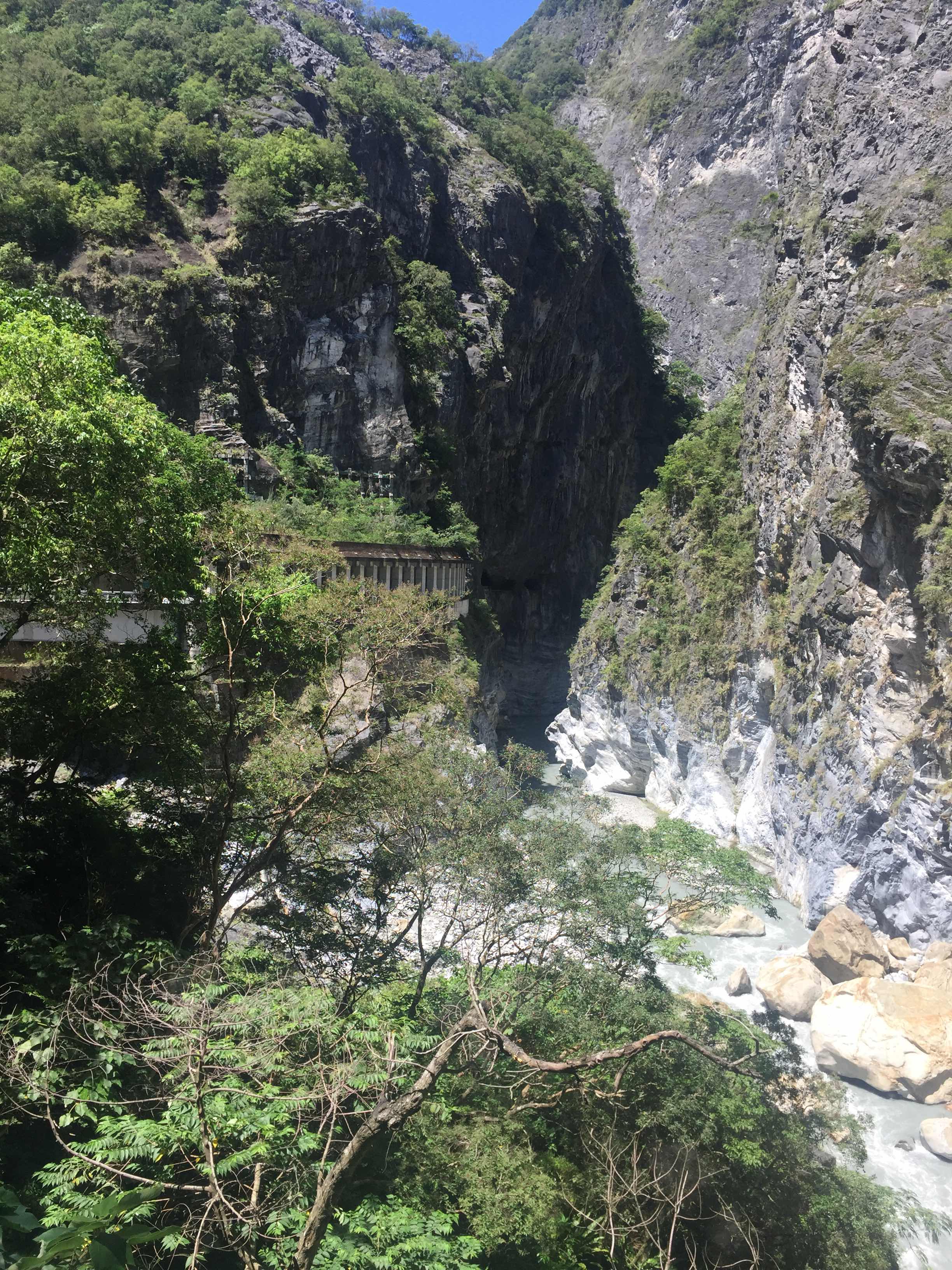

We pressed on, the valley rose before us (my photos do not do justice to the beauty of the gorge ), the bus travelling on the cliff edge with the spectacular valley beneath us.


We entered numerous tunnels, crossed interestingly
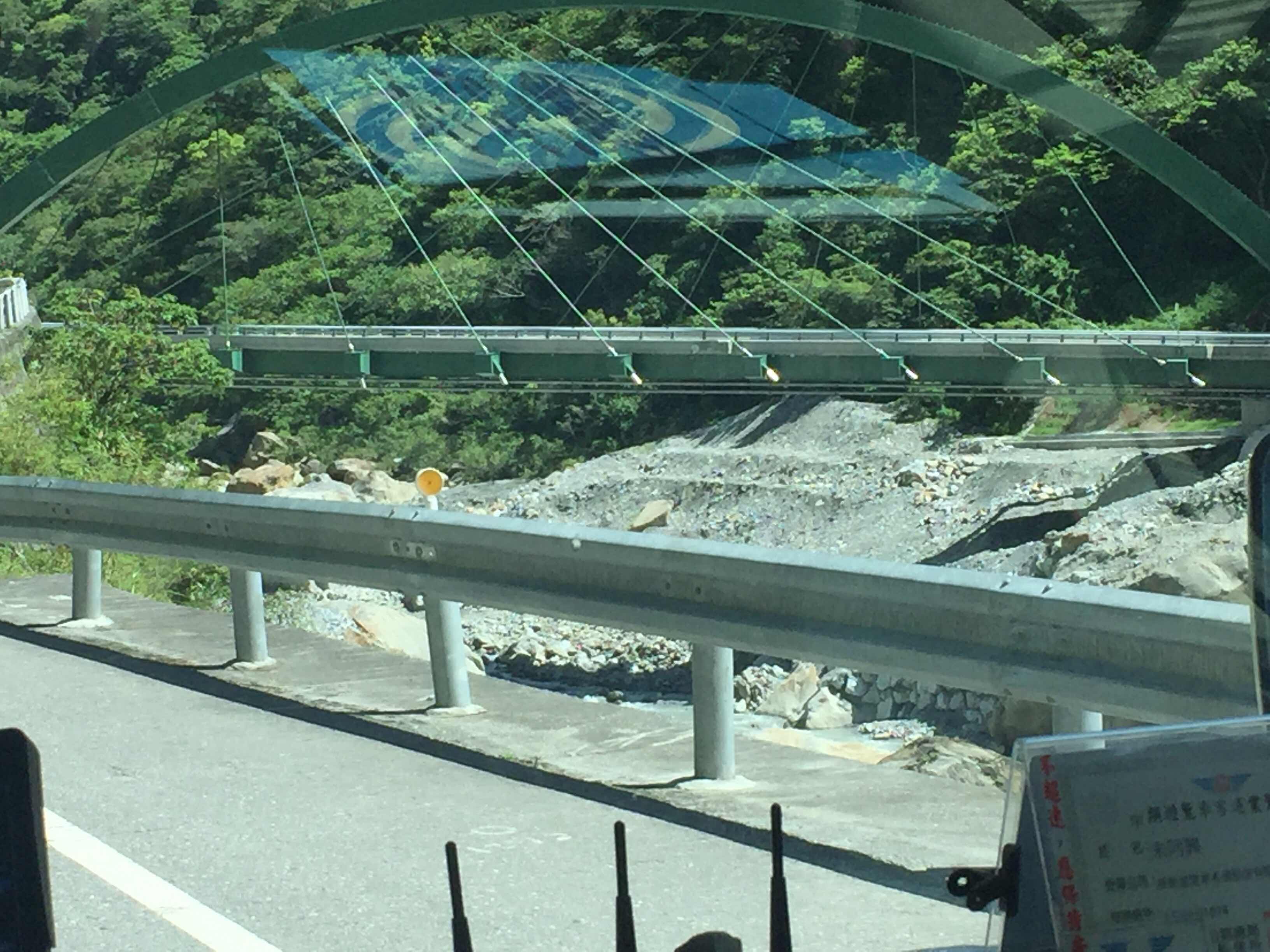


designed bridges until we arrived at Tianxiang, where we lunched.
Tianxiang is one of the small towns that dot the gorge. It has a Temple also! We did not climb to the Hsiangte Temple, named after a Buddhist monk, who prayed for the safety of the workmen as they built Central Cross Highway. The Temple was perched high among the trees on the valley side. I think we got a sufficient flavour of temples in Tainan!!

We sat out under the shade, having purchased our lunch which included sushi - the Japanese influence is reflected in their food. We were joined by four young people, who enquired as to where we were from? They were holidaying from Kuala Lumpur. One of the party was quite familiar with Ireland as he had studied at Liverpool University. He now worked in Singapore. So engaged were we in conversation that our driver had to beacon us to the bus.
After lunch, we returned down the gorge once again. We alighted at Changchun Shrine, with its eternal waterfall, again dedicated to those who died in the road’s construction.

Its waterfall is eternal!


The view of the valley below

At each stop there are many scenic trails, from short and easy as the Buluowan Trail at 400m, a 20 minute walk, to the Shakadang Trail, at 4,100m which takes 3-4 hours round trip. There are 4 hiking trails trails regarded as easy as they are flat - the highest at 10,600 m (6-7hours) and Mountaineering Trails - the 10,300m -a 1 day walk.
We left the park. We had spent 5 hours there with a 40 minute lunch break and we hadn’t noticed the passage of time so absorbed were we in the terrain. It is a truly an amazing place.
Having quitted the Gorge, as is usual on tours were taken to a shop, which in fairness had a display of the agricultural history of the area. It appears this area is a pastoral farming area. As we’ve travelled through the country, there was an absence of animals in the fields but here dairying is practiced. The reasons are thus: historically it appears the farmers realised that s typhoon’s wind and rain flattened their crops while pastoral farming wouldn’t suffer the same fate. In addition, the area had little industry, therefore little pollution and so farmers could promote their products as ‘green’ Downstairs was displayed the widest selection of sweets I have ever seen! I’m not a fan of any of the sweets I’ve tasted, thus I refrained from purchasing.
Our next stop was the beach but as we aporoached the Civil Defence were preparing to close the parking lot. We were allowed to park but as we approached the beach, we were told to return to the car park

A typhoon was expected at 16.00!! It was now 15.30! I assume their concern was that a sudden tsunami might drown us all! The mountains looked ominous!!

(I recall a holiday in Malaysia some years ago. We arrived just after a tsunami had hit the area. One of the waiters describes serving on the beach, when suddenly, looking out to sea, he saw the water being sucked up and a massive wave heading for the foreshore. All guests were alerted and disappeared inland. Afer the tsunami had passed, one little boy was missing but he was found sitting safely on top of a roof - thankfully no one was killed.) We departed!

Our final stop was The Hualien Brewery. We had a tasting of their drinks - whiskies. We purchased!!
On our return to the Liga Hotel , excellent with the exception of the infrequent wi-fi, we rested before walking to the train station, where the Visitor Centre was not quite as helpful as to date, in order to purchase tickets for Ruifang - a town on the Pingxi railway line, which we’ll take tomorrow. The staff st the Information Centre were most helpful and insisted we jump the queue much to the chargin of the locals.!!
We went in search of dinner. As I previously mentioned, the Chinese appear to drink little. One young guest recommended the Milky Tea (a great favourite here). No alcohol here - guess who wasn’t pleased? It reminded us of the ‘Family Restaurants’ in the southern US states as we drive ‘Route 66’ We eventually found a Japanese restaurant selling beer (wine is a rarity) and had a spectacular meal - no cutlery -we’re getting quite adept with the chop sticks!!
Today as I write this blog, I’m here awaiting the washing to finish. When one is travelling so light, washing facilities are a must and they are available at most hotels.
The rain has arrived. It is coming down in buckets and there is thunder and lightening.! If there are trips to Taroko Gorge today, access will be limited to sites if any, as there is a grave danger of slipping. The Gorge authorities are cogniscant of one’s safety (hard hats). It would be miserable in any event!!
We’re off to the train station - Ruifang .......